For the past several years, the conversation around AI in creative industries has largely focused on replacement, disruption, and automation. But from my perspective as someone who has spent more than three decades working in visual production, visual effects, motion graphics, compositing, and technology training, I see something different happening.
The real opportunity isn’t simply generating content faster.
It’s building smarter production workflows.
The tools are evolving rapidly — sometimes weekly — but the fundamentals of communication, storytelling, visual design, pacing, production planning, branding, and audience engagement still matter. In many ways, they matter more than ever.
What AI changes is the relationship between creative ideas and execution.
Tasks that once required large teams, specialized departments, or expensive infrastructure can now be explored, tested, and iterated on much more quickly. But these tools still require direction, workflow thinking, and creative judgment to produce professional results consistently.
That’s where I believe the next generation of creative technology consulting is headed.
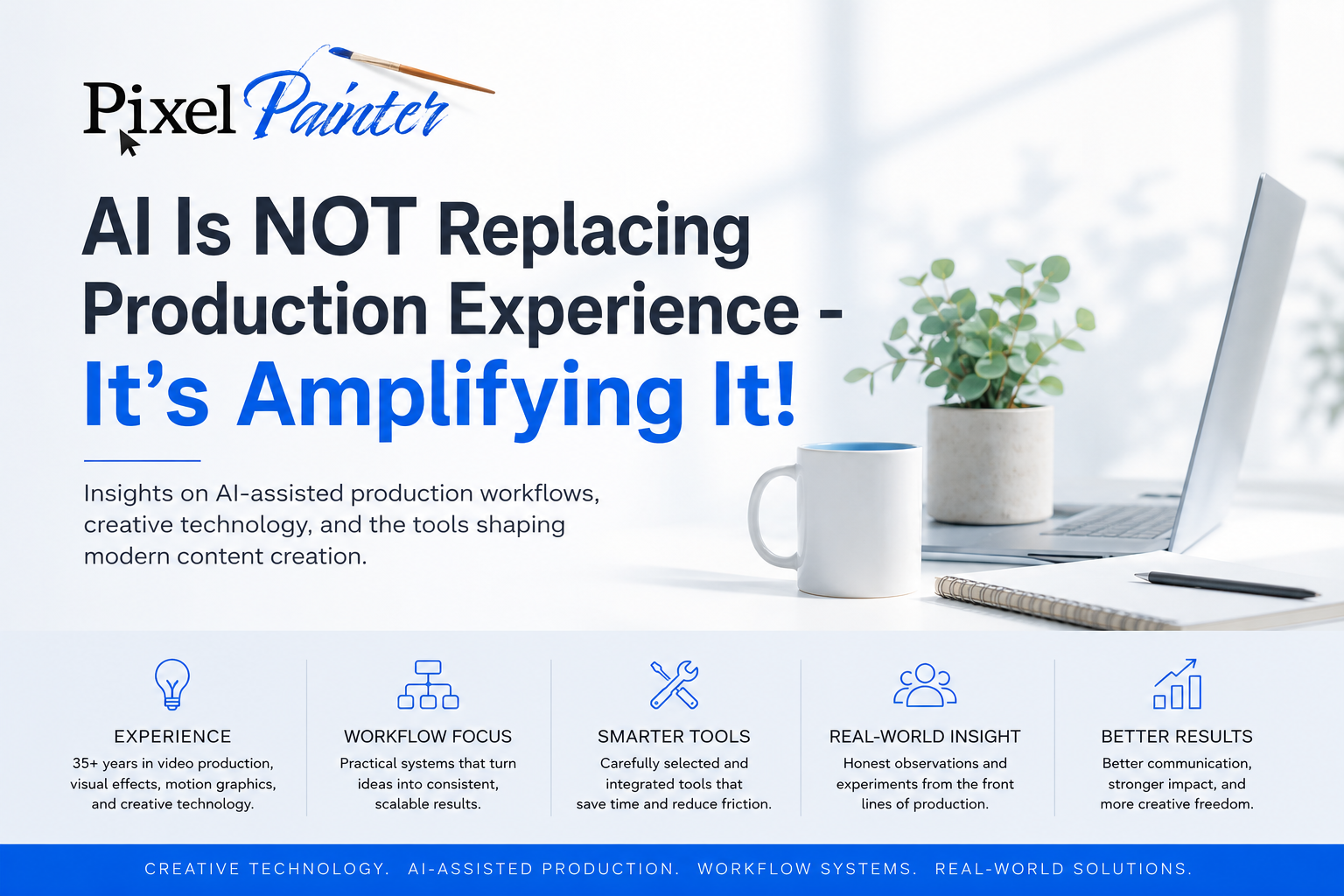
Why Workflow Matters
One of the biggest misconceptions surrounding Generative AI is the idea that the tools themselves are the solution. In reality, most professional production environments succeed or fail based on workflow — how ideas move from concept to execution in a repeatable, organized, and scalable way.
The AI tools are evolving rapidly, but without structure they can quickly create chaos instead of efficiency. File management, prompt consistency, branding, revisions, voice direction, pacing, scene planning, compositing, rendering, editing, and delivery still matter. In many ways, they matter more now because the speed of content creation has increased dramatically.
The real value isn’t simply generating images or videos faster. It’s building workflows that allow creators and businesses to consistently produce quality communication systems without reinventing the process every time a new tool appears.
Why Tool Overwhelm Is Real
Every week new AI platforms appear claiming to revolutionize video production, image generation, voice cloning, animation, editing, music creation, or automation. For many creators and businesses, the biggest challenge is no longer access to tools — it’s knowing which tools actually matter and how they fit together.
The result is that many people spend more time experimenting with disconnected software than actually producing finished work.
That’s one of the reasons I’ve been developing browser-based workflow tools and production systems through Pixel Painter. The goal isn’t to chase every trend, but to help simplify decision-making and reduce the friction between creative ideas and execution.
The problem isn’t a lack of technology anymore.
The problem is navigating it intelligently.
Why Practical Integration Matters
There’s a big difference between AI-generated content and professional production workflows.
Many demonstrations online focus on isolated “wow moments” — a generated image, a talking avatar, a short animation clip, or a voice clone. But in real-world production environments, these elements still need to integrate into larger communication systems that include branding, storytelling, pacing, editing, sound design, delivery formats, client revisions, and platform requirements.
That’s where practical integration becomes important.
The goal isn’t simply to use AI tools because they exist. The goal is to understand how these technologies can be integrated into existing production pipelines in ways that save time, improve flexibility, and expand creative possibilities without sacrificing quality or consistency.
Why I’m Building These Workflow Tools & Systems
As I continued exploring AI-assisted production workflows over the past several years, I realized that many creators and businesses were struggling with the same challenges repeatedly:
- Which tools should I use?
- What order should I use them in?
- How do I write better prompts?
- How do I organize production planning?
- How do I maintain consistency?
- How do I scale this process professionally?
The tools I’m building through Pixel Painter are designed to help bridge that gap.
Rather than functioning as isolated software products, they’re intended to work together as part of a broader production ecosystem focused on workflow clarity, creative planning, prompt development, and real-world production execution.
The goal isn’t to replace creativity.
It’s to reduce friction so creators can spend more time communicating ideas and less time wrestling with constantly changing technology.
How Professionals Can Adapt Without Panic
I understand why many creative professionals feel uncertain right now. Every part of the production industry is being affected by rapidly evolving AI technologies, and the pace of change can feel overwhelming.
But I don’t believe the future belongs solely to automation.
I believe it belongs to people who understand how to combine creative judgment, production experience, communication skills, and evolving technology into practical workflows that solve real problems.
Beyond the flash of the AO tools, the fundamentals still matter:
- storytelling
- pacing
- composition
- editing
- design
- communication
- audience engagement
- creative direction
AI simply changes how quickly ideas can move through the production pipeline.
For experienced professionals, this moment represents an opportunity to evolve existing skills rather than abandon them. The tools will continue changing, but the ability to guide creative systems intelligently will remain incredibly valuable moving forward.
As I continue developing the Pixel Painter AI-assisted production ecosystem, I’ll be sharing workflow experiments, production insights, technology breakdowns, and practical observations here on the blog as these tools continue evolving.
The goal isn’t hype.
It’s understanding how to integrate these technologies into real-world professional production systems that actually work.